


I’ve known Dr Goodman for several years, and he has helped me through some serious problems. Dr Goodman walked me through using some very helpful tools, journaling, mindfulness even breathing techniques when I am anxious . Dr G will help you because he listens to you. (He likes dogs? ) Thanks Dr!
Stress
Biofeedback, hypnosis, relaxation, breathing, mindfulness, meditation and ACT therapy combine to give you the coping skills to calm an overloaded nervous system.
Stress in a Modern World
While cave man probably only raised his Sympathetic Nervous System (SNS) when he had to hunt the Saber Tooth Tiger, today, it seems everything is a Saber Tooth Tiger to us. We are on constant SNS overload feeling as if everything around us could attack us. Terrorism, finances, jobs, family, relationships, illnesses, etc., all combine to keep the SNS engaged. Similar to driving a car where the idle is stuck on high which eventually causes the engine and all the parts to burn out.
Biofeedback, Hypnosis, Relaxation, visualization, breathing and Mindfulness, Meditation and ACT therapy all combine to provide coping skills for us to proactively engage the Para-sympathetic system thus shutting down the SNS and allowing that idle to finally come back down to normal. This is how we can return to a powerful state of health; becoming parasympathetic dominant.
The Sympathetic and Parasympathetic Nervous System
The Human Body is the most amazing machine ever invented. At the speed of light, decisions are made regarding whether to run or whether to fight. When the Sympathetic Nervous System (SNS) is engaged, the body hunkers down, goes into stress mode and begins releasing cortisol, adrenaline, epinephrine, and a whole host of other proteins, enzymes and hormones. This raises blood pressure, increases heart rate, raises body temperature and brings blood up to the head and heart to protect these vital organs.
Stress, the Human Body, and Disease
For years we have known that stress and disease are intimately linked. When we lower stress our body can heal. When stress lingers over time, the body breaks down.
Breathing as the Number One Coping Mechanism
The most insidious catch-22 in physiology and anxiety is the following: When we breathe wrong we become anxious and when we are anxious we breathe wrong. The easiest and most fundamental way to decrease anxiety is to engage in proper breathing techniques.
A Different Disorder
Anxiety, performance anxiety and depression are related but distinct. Understanding the difference is the first step to managing each.
Anxiety
Sigmund Freud theorized that anxiety was at the core of most issues that we as human beings deal with. This anxiety is often defined as an inner state of conflict which drives people to escape through various means. Aside from using defense mechanisms as a form of escape, we often use other means such as drugs, medications, impulses, shopping, gambling, hair pulling, nail biting, smoking, etc.
Anxiety is often connected to such issues as ADD and ADHD, Bi-polar disorder, impulsive disorders, PTSD, other mood disorders and even depression. Mindfulness, hypnosis, relaxation all serve to decrease anxiety and therefore ameliorate many of these issues.
Performance Anxiety
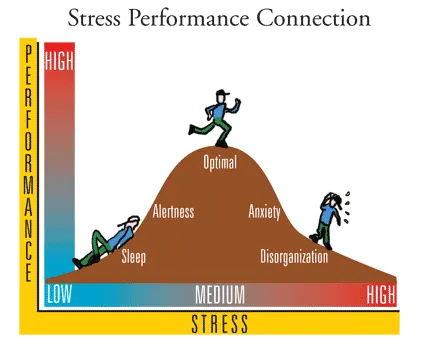
Whether its tests, auditions, speeches, stage performances or sports competitions, anxiety brought about by an overriding fear of embarrassment and rejection will often creep into our experiences and negatively effect the outcomes. Research has shown that while too much anxiety is not desirable for a good performance, too little can have the same negative outcome. The image of the Yerkes-Dodson Theory of Anxiety illustrates how too little or too much anxiety is not desirable.
So how do we find a happy medium? There is a prevalent notion in the world that what we need to do is eliminate the anxiety. Nothing could be further from the truth. What is actually needed is to properly be able to manage anxiety and use it to our benefit. Dr. Goodman will guide you through a series of cognitive behavioral exercises combined with neurohypnologic visualizations designed to alter the memory of past negative traumas as well as implant suggestions for present and future successes.
Depression
Depression and anxiety disorders: not the same. Depression and anxiety disorders are different, but people with depression often experience symptoms similar to those of an anxiety disorder, such as nervousness, irritability, and problems sleeping and concentrating. But each disorder has its own causes and its own emotional and behavioral symptoms.
Many people who develop depression have a history of an anxiety disorder earlier in life. There is no evidence one disorder causes the other, but there is clear evidence that many people suffer from both disorders.
Ask About a Free Consultation
In-office or virtual sessions available. Start with a simple, no-obligation conversation.
Testimonials